
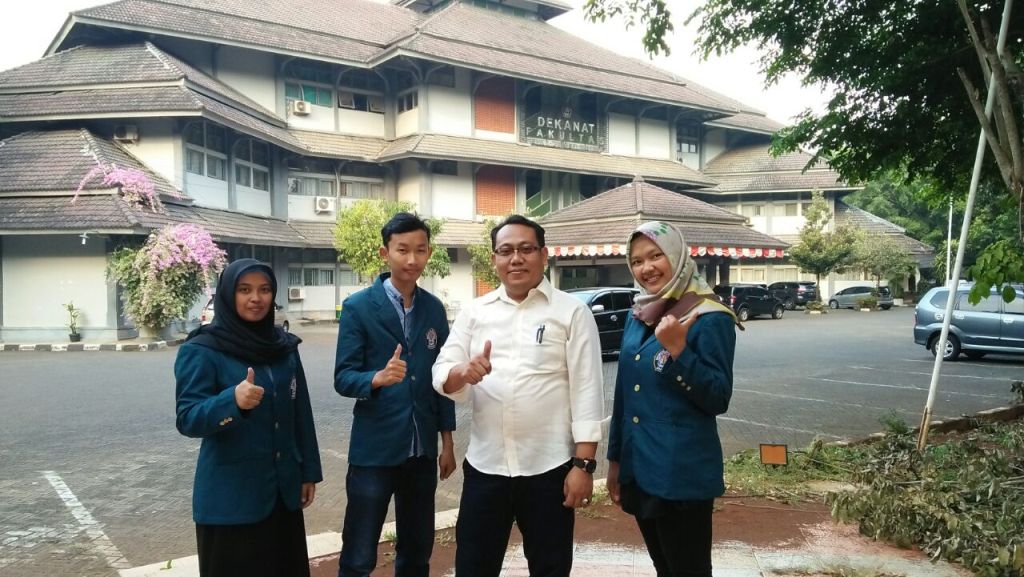
Faculty of Engineering – Diponegoro University students Nanda Al Faizah (Physics 2016), Nurwarrohman Andre Sasongko (Chemistry 2015), and Hani Ma’rufah (Physics 2016) under the guidance of Prof. Dr. Heri Sutanto, S.Si., M.Si conducted research to analyze and utilize iron rust waste (Fe3O4) into Fe3O4 nano magnetic material as a solution to environmental pollution by iron rust waste (Fe3O4).
“Currently, iron or metal rust waste is just thrown away without seeing its impact on the environment. In fact, iron waste such as roofs, car bodies, used hinges, and goods in nature are only collected and sold to collectors of used goods at low selling prices.” Nanda said.
“Corrosion of iron (Fe) that occurs in nature can produce iron oxide Fe3O4. Fe3O4 is a metal oxide with the strongest magnetic properties. The magnetite (Fe3O4) phase found in iron oxide has good magnetic properties and is higher than other phases such as Fe2O3.” Nanda added.
“Nanotechnology is the manufacture and use of materials at very small sizes (1 nanometre is equivalent to 10-9 metres). If Fe3O4 material is made in nanometre size, it will have its own characteristics compared to macro material. Nano-sized Fe3O4 has ferromagnetic properties and has wide application opportunities. One of the advantages of this magnetic is that its ferromagnetic properties are able to absorb electromagnetic waves through the mechanism of magnetism, especially against metal atoms or ions that are paramagnetic. One way to resize Fe3O4 into Fe3O4 nano size is HEM (High Energy Milling). HEM is a high-energy milling or grinding process. The engineering of nanoparticle materials in this way reaches below 10 nm.” Andre said.
Fe3O4 nano magnetic material has a higher selling value when compared to iron rust waste which is directly sold to scrap collectors without any modification. It is hoped that this research can reduce the pollution problem caused by iron rust.